
The decision
The AI tax is rarely caused by capability. It is caused by decisions made before exposure is priced. Fit is assumed. Data rights are unclear. Vendor terms are accepted by default. Ownership is implied, not assigned.
The real question is simple: is this a decision we can defend under scrutiny? That requires pricing the cost of inaction, the cost of failure, and the cost of reversal � then choosing a position based on evidence, not momentum.
This note exists to help you reach a defensible GO, GO with conditions, or NO GO position before commitments become expensive to unwind.
Signals you might recognize
- The basics can't be answered on demand. What is in scope, who owns it, what data it touches, and what vendor terms apply?
- AI changes bypass change control. Prompts, retrieval sources, and "small tweaks" ship without release discipline.
- Data rights are assumed. Legal basis, purpose limitation, retention, cross-border handling, and internal policy boundaries are not explicit.
- Contracts favor convenience. Audit rights, liability boundaries, data handling, and exit options are vague or missing. Integration effort is treated as "implementation detail", but the operational and compliance constraints still belong to you.
- Quality is judged by demos. Success is defined by anecdotes instead of repeatable evaluation tied to real use cases.
- No named owner with override authority. AI influences material outcomes, but escalation and accountability are unclear.
If any of these feel familiar, you are likely already paying the AI tax for adoption decisions made without the full picture.
The mechanism
The AI tax follows a predictable pattern. A pilot succeeds. It becomes a commitment. Scope expands faster than evidence, rights, and ownership can keep up.
The impact is not that someone asks for an explanation. The impact is that scrutiny requires proof. When a customer dispute, audit request, or incident arrives, leadership must show what was approved, what data was in bounds, what terms applied, and who owned the decision. If that proof does not exist, the organization pays in delay, retroactive rework, and forced constraints.
When adoption outpaces evidence, you pay twice. Once to ship. Then again to reconstruct defensibility under pressure.

Board-level decision questions
AI becomes expensive when it is approved before boundaries and ownership are explicit. These questions are designed to prevent that. They force one thing: a decision that remains defensible under scrutiny, with cost exposure priced up front.
- What decision or outcome depends on it, and who is impacted
- What happens when it fails, degrades, or is disputed, and what the fallback is
- Why AI is appropriate for this use case, beyond a demo or a pilot narrative
- Do we have the rights to use the required data in this way, for this purpose
- Are we within applicable data protection laws, internal policy, and cross-border constraints
- What data is allowed, what is prohibited, and what must remain within controlled boundaries
- Who owns the risk and outcome, with a clear escalation path and decision authority when risk is disputed
- Are vendor terms aligned to auditability, liability boundaries, logging limits, and exit options
- What cost exposure expands with usage, and what constraints must exist before scaling access
If these questions cannot be answered with evidence on demand, the organization is already paying the AI tax through delay, retroactive rework, exposure, and loss of credibility.
System map
AI accountability is not owned by "the AI team". It spans the company's operating system � architecture boundaries, delivery discipline, controls, incident readiness, and data governance.
That's why tool-only fixes disappoint. If the operating model can't assign ownership, preserve evidence, and gate change, risk returns even with better technology.
Evidence ledger
Governance must be provable. It is not what you believe about your controls. It is what you can show when challenged.
Evidence can be lightweight, but it must exist. Inventories, approvals, logs, tests, owners, and decision records. Without it, the organization is managing AI by trust and momentum.
This is not bureaucracy. It is the difference between moving fast and paying later.

Consequence model
- Mispriced dependency: AI becomes embedded in decisions before failure cost and fallback posture are defined.
- Reactive reconstruction: audits, incidents, and escalations force expensive reconstruction of scope, data use, and approvals.
- Vendor exposure: terms optimize convenience, not auditability, liability boundaries, or exit options.
- Data rights risk: retrieval, logging, and cross-border handling expand legal and compliance exposure if boundaries are not explicit.
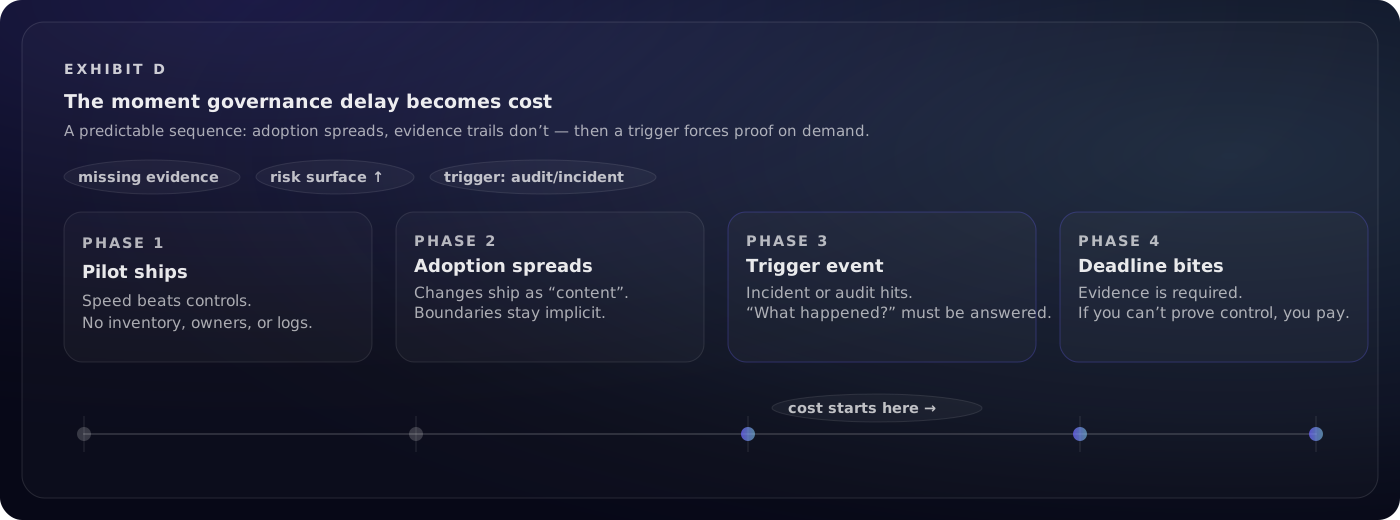
The tax is not theoretical. It appears as delay, rework, missed windows, and credibility loss when decisions face scrutiny.
How the tax hits the business
- Decision drag: approvals slow down because leaders cannot defend boundaries, rights, and ownership.
- Rework cost: evidence and controls get built after commitments, under pressure, at a higher price.
- Contract cost: vendor terms get set before accountability is priced, and the exit becomes expensive later.
The Decision Gate exists to convert uncertainty into a defensible position, so the organization can move without buying hidden exposure.

The Decision Gate
The Decision Gate is the fast entry point. It is an Acquiris-led decision review designed to give an accountable owner a defensible position quickly. The outcome is a board-ready stance: GO, GO with conditions, or NO GO.
It stays intentionally lightweight. It exists to reduce decision delay and make exposure visible before commitments harden. For deeper analysis, strategic planning, and execution support, Acquiris can engage through ACQU.
What you receive is a concise decision record you can stand behind, with evidence attached where it exists: scope, boundaries, ownership, vendor terms, and the conditions required to proceed safely.
If the position is GO with conditions, we translate gaps into conditions with named owners, written deadlines, and the evidence required to remove exposure. Follow-on support is optional.
This is a readiness test. Acquiris issues a position only when the decision can be defended with evidence. If evidence for the critical items cannot be produced, the default position is GO with conditions with named owners and deadlines. If core proof is missing, the position is NO GO until it exists.
The decision is defensible end to end: scope ? ownership ? inventory ? data boundaries ? traceability ? evaluation ? change discipline.
You can proceed only if gaps are explicit, assigned to named owners, and sequenced with written deadlines before exposure expands.
The decision is not defensible. Core evidence is missing, or boundaries and ownership cannot be proven on demand.
Use these lines in steering committees and decision memos. Attach evidence (links, artifacts, logs, named owners). Narrative alone does not clear the gate.