
When Change Governance Creates Fragility (and how to unwind it in 90 days)
In big organizations, ticket-based CAB governance is often the real source of slow delivery and instability, not tools or team skill. The post shows the typical symptoms (lead time spikes around release windows, higher failure on ticket-approved changes, rollback/hotfix bursts, owner bypasses), then uses the ACQU framework to 1) prove whether governance is the breakpoint, 2) quantify its cost with 90 days of change/incident data, and 3) design a 90-day “unwind” based on smaller, safer releases, owner accountability, clear guardrails, and hard metrics. It closes with concrete risk scenarios (shadow changes, overloaded owners, alert noise), mitigations, and a short self-check so teams can see if their governance model is holding them back.
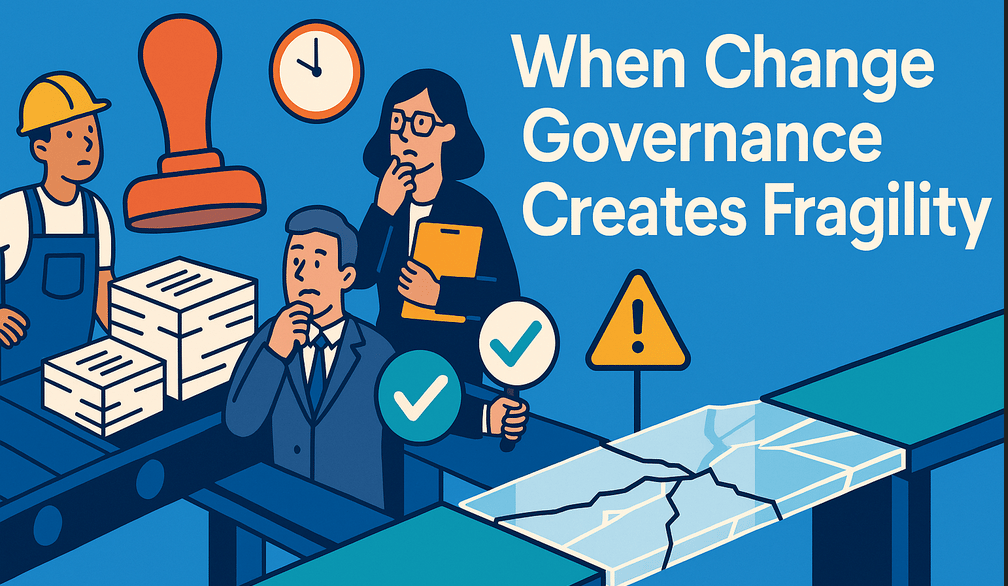
Most large organizations still rely on ticket-driven change approvals (CABs, multi-step workflows, generic templates). The intent is risk reduction but the outcome, more than often, is quite the opposite: long lead times, higher change failure rates, and incident bursts clustered around release windows. This pattern hides in plain sight because each step looks reasonable, templates are familiar and tested, so they are safe, right? But it is only when you connect architecture, risk/governance, and daily operations to the picture that reality really snaps into focus.
This article shows how we use ACQU to A) identify if governance is really a breakpoint in your company, B) quantify its cost, and C) design a 90-day unwind that improves safety and flow with the tools and teams you already have.
What the pattern looks like in production
Lead time spikes before month-end or quarter-end windows
Change failure rate disproportionally higher for “ticket-approved” changes vs. owner-approved paths
Rollback frequency and hotfixes increasing after “big bang” releases
Escalations that bypass stated owners (people page the person who “can actually fix it”)
Runbooks stale or missing for the riskiest changes; approvals rely on template text rather than evidence
Alert noise around deployments; time-to-detect (TTD) depends on customer complaints
These symptoms are often misattributed to tooling or team skill. In many environments, the governance model is the true constraint, why? Let's deep dive into the first one as example:
Lead time: Being the time from change start (e.g., ticket opened/PR (pull request or merge request in git lab, created) to change in production.
Spikes before month-end/quarter-end windows: in the days leading up to a scheduled release or financial close, that lead time jumps sharply compared to normal days. It's slower and more difficult to get things going through the governance model.
Why it happens (common causes)
Batching & freeze windows: Teams hold changes for a “big drop,” then everyone merges at once → queues and approvals get in each others way.
CAB bottlenecks: Extra sign-offs needed, more burocracy near closing periods slow everything.
Risk aversion surges: More checks, more coordination, more handoffs, more concern as we are in a fiscal moratorium, maintenance, end of quarter and so on.
Coupled deploys: Many services must land together, separated deploys that should have beeing done in a single one; if one lags behind it delays it all.
Hidden work peaks: Finance/ops reconciliations compete for the same people/systems. Example: Operations need to do maintenance on a datacenter but Finance needs the systems up to do the financial close. One work around the other while issues happen and stretch support teams thin between them.
How to confirm (simple checks)
Plot daily lead time (percentil 50% and percentil 95%) for the last 90 days; mark month-end and quarter-end.
Compare owner-approved vs ticket/CAB-approved changes in those weeks.
Check queue age for approvals and rollback/hotfix spikes after the window.
Why it’s a problem
Slower value delivery exactly when the business needs stability.
Higher change failure rate (large batches, rushed merges).
Incident clusters after "big" releases → MTTR, MTRS and customer pain rise.
Typical fixes (90-day unwind pattern)
Smaller, more frequent releases: “release trains” instead of end-of-month dumps. Better schedule requires better planning.
Guardrails over generic approvals: clear pre-conditions (tests, rollback, monitoring) with owner approval for standard changes.
Progressive delivery: canaries/feature flags to de-risk flow.
Limit WIP before close: freeze only high-risk classes; keep low-risk changes flowing.
Measure & publish: weekly lead time and failure % by change class so behavior sticks.
ACQU in practice: detecting governance as the breakpoint
A — Assessment (baseline & hypotheses)
We align on the promise that matters this quarter (e.g., “payments authorize within 2s at p95”) and choose 2–3 critical journeys. Typical hypotheses to prove/disprove:
“Ticket-driven approvals increase lead time and correlate with higher change failure rate.”
“Deployment windows concentrate risk and extend MTTR/MTRS when failures occur.”
“Absence of owner accountability causes escalations to leap out of the on-call tree.”
What we look at: lead time distribution by change class, change failure %, rollback rate, MTRS, incident clusters vs. release calendar, ownership clarity in the critical path.
C — Collaborate (get the minimum viable dataset)
Read-only access plus 6–10 short interviews with key actors. Artifacts:
90 days of change/deploy history (service, team, approval path, success/fail, rollback)
Incident log with severity, MTTR/MTRS, and linkage to recent changes, RCA and associations.
SLOs/alerts for the selected journeys, against expected SLAs
Ownership map and runbook index for change types that routinely cause incidents
We validate “how it really works” vs. documented intent.
Q — Quantify (turn observations into impact)
Lead time: median and p95 by approval path (owner vs. ticket/CAB)
Change failure rate: #failed / #total by path and by change type
Rollback/hotfix rate around windows
Cost framing:
We grade confidence based on data quality and sample size.
U — Unify (select the top breakpoint and design the 90-day sequence)
We rank candidates with a simple rubric: Impact, Prove-ability, Time-to-Value, Compound Value. When governance wins, the signals usually agree: higher failure rates and longer lead times for the ticket path, plus incident clusters around release windows.
What the evidence often shows (example taken from median of companies open data.)
Owner-approved path: median lead time 1.8 days, change failure 9%
Ticket/CAB path: median lead time 7.4 days, change failure 18%
Rollback rate spikes 2.2× in window weeks
Escalations bypass stated owners in 37% of incidents linked to changes
Even without new tools, these deltas point to a governance problem that can be unwound quickly. 9% might look little, but it just says 1 in 10 of your changes are failing, which is not a small number if you have hundreds a years. How much that rework cost?
A 90-day unwind that improves safety and flow
The goal is not to “go fast and break things.” It’s to replace generic approvals and bad templates with accountable ownership and explicit guardrails that work for your company, so risk decisions are closer to the code and easier to audit.
Guardrails to standardize (week 1–3)
Change classes improving the pre-conditions (tests, rollback plan, monitoring in place)
Owner approval as default for Class B changes that meet pre-conditions
Progressive delivery default (small batches, feature flags, canary before big deploy)
Alert precision checks tied to SLOs (reduce noise before raising throughput)
Accountability & rehearsal (week 3–6)
Publish a RACI for change decisions on the selected journeys, instruct the teams on their roles on it.
Tabletop rehearsals for the top two failure modes (verify runbooks, rollback paths, comms), see where it is failing the most and adjust whats causing it, do proper RCA and Problem Management.
Flow adjustments (week 4–8)
Break “window weeks” into daily release trains if necessary, always with rollback windows accounted.
Introduce pre-merge checks enforced by CI (evidence > template text)
Route exceptions to a small, time-boxed review cell (measured by queue age and avoiding that these exceptions clog the regular approval path)
Measurement (continuous, visible)
Track lead time, change failure %, rollback rate, TTD/MTTR by change class
Publish a weekly one-pager for the exec sponsor: what moved, why, what’s next
What changes culturally
Risk is owned, not waved through.
Approvals are evidence-based, not template-based.
Releases become smaller, more frequent and well understood and less surprising to all involved.
Expected effect sizes (typical ranges)
Lead time: −25% to −50% for the affected change class
Change failure rate: −20% to −40% overall and with the same tools/teams
MTTR/MTRS: −25% to −40% on incidents caused by change
Escalations: fewer cross-team bypasses as ownership clarifies
Real numbers will depend on baseline and adherence to new rules and guardrails.
Risks & mitigations
A) Shadow changes bypass the new path
Problem: People deploy outside the approved flow (no review/traceability). Mitigations (concrete):
Enforce in Continuous Integration/Continuous Delivery: protected branches, required reviews, mandatory checks (tests, coverage, vulnerability scan) before merge.
Deployment permissions: only pipelines with signed artifacts can deploy; block manual prod kubectl/SSH and similar.
Drift detection: nightly diff “what’s in prod vs what’s in repo”; page on mismatch.
Progressive delivery defaults: flags/canary + auto-rollback on SLO breach.
Audit & reconciliation: weekly “unmatched deploys” report; anything not tied to a change record is investigated.
Metrics: % of prod changes with a linked PR/build; count of unmatched deploys; time-to-detect config/code drift.
B) Approvals move from ticket queue to overloaded owners (rubber-stamping)
Problem: You killed the CAB queue but created a human bottleneck; owners start clicking “approve” without review. Mitigations:
Classify changes (A/B/C or other classification) : B-class allowed on owner approval + guardrails; C-class to a small review cell (time-boxed).
Auto-gates > human checks: CI proves preconditions (tests, rollback, monitoring) so owners review substance, not templates.
Limit WIP & queue age: cap concurrent reviews; publish queue-age p95; auto-reassign when SLA breached.
Rotation & delegation: duty owner per service; documented delegates to avoid single-person pile-ups.
Metrics: owner queue-age p50/p95; review throughput/day; % approvals with all preconditions satisfied; rework after approval.
C) Noise + fear of delays hide regressions
Problem: Alerts are noisy, people fear “slowing delivery,” so real regressions slip through. Mitigations:
Alert precision first: dedupe, tighten thresholds, tie alerts to SLOs/SLIs; kill noisy rules before increasing cadence.
Error-budget policy: if budget is burning, reduce risky changes; if healthy, allow higher throughput.
Automatic rollback: canary/p95/p99/err-rate guards trigger rollback without debate.
Weekly quality report: visible dashboard of SLOs, incidents-linked-to-change, and regressions found post-deploy.
Metrics: alert precision (true/false positive rate), SLO error-budget burn, change-linked incident rate, auto-rollback count, time-to-detect.
Why bother listing these?
Because governance fixes can backfire if you don’t plan for human workarounds, bottlenecks, and signal noise. Calling them out—and attaching controls + metrics—makes the 90-day unwind robust and auditable, not just aspirational.
Quick self-check: do you have a governance breakpoint?
Answer yes/no to each:
Do “ticket-approved” changes have >2× the lead time of owner-approved changes?
Changes approved via the ticket/CAB are statistically higher failure rate than changes approved by an accountable owner, for the same services?
Do incidents cluster around release windows?
Are runbooks missing or stale for the riskiest change types?
Do escalations frequently skip the stated owner?
Three or more “yes” answers suggest governance—not tooling—is your primary constraint.
What to bring if you want to replicate this analysis
Last 90 days of change/deploy history (with approval path and outcome)
Incident list with severity, MTTR, and “linked to change?” flag
SLOs/alerts for one critical journey
Ownership map and runbook index for that journey
With these, you can reproduce the baselines and see whether governance is your breakpoint.
CONTACTS
contact@acquiris.digital


ACQUIRIS DIGITAL © 2025